Production 2026
Come Out
Creation and conception
Olivier Dubois
Art assistant
Cyril Accorsi
Music
Steve Reich « Come Out », 1966
Performers
Esther Bachs Vinuela, Lara Chanel, Malgorzata Coello Czajowska, Jean Colombet, Charlotte Crouin, Jacquelyn Elder, Rose Ellen Lewis, Coline Fayolle, Steven Hervouet, Matteo Lochu, Yann Louvrier Saint-Mary, Nicola Manzoni, Rémi Richaud, Rafaël Sauzet. In rotation: Yohann Baran, Anahita Roman-Barthe
Technical direction
François Michaudel
Sound management
François Caffenne
Creation and lighting design
Emmanuel Gary
Costume design
Martine Augsbourger
Duration
55 minutes
Production
Compagnie Olivier Dubois
Coproductions
Philharmonie de Paris ; Fondation Fiminco ; L’Onde Théâtre – Centre d’Art de Vélizy-Villacoublay ; Théâtre GRRRANIT Scène nationale Belfort ; MAC – Maison des Arts de Créteil, Scène nationale ; Centre des arts d’Enghien-les-Bains, Scène conventionnée d’intérêt national Art et création pour les écritures numériques et le spectacle vivant ; Julidans
Action financed by
La Région Ile-de-France, le Fonds de dotation Francis Kurkdjian
With the support of
Théâtre GRRRANIT Scène nationale Belfort (creation residency), CCN de Créteil et du Val-de-Marne (audition residency)
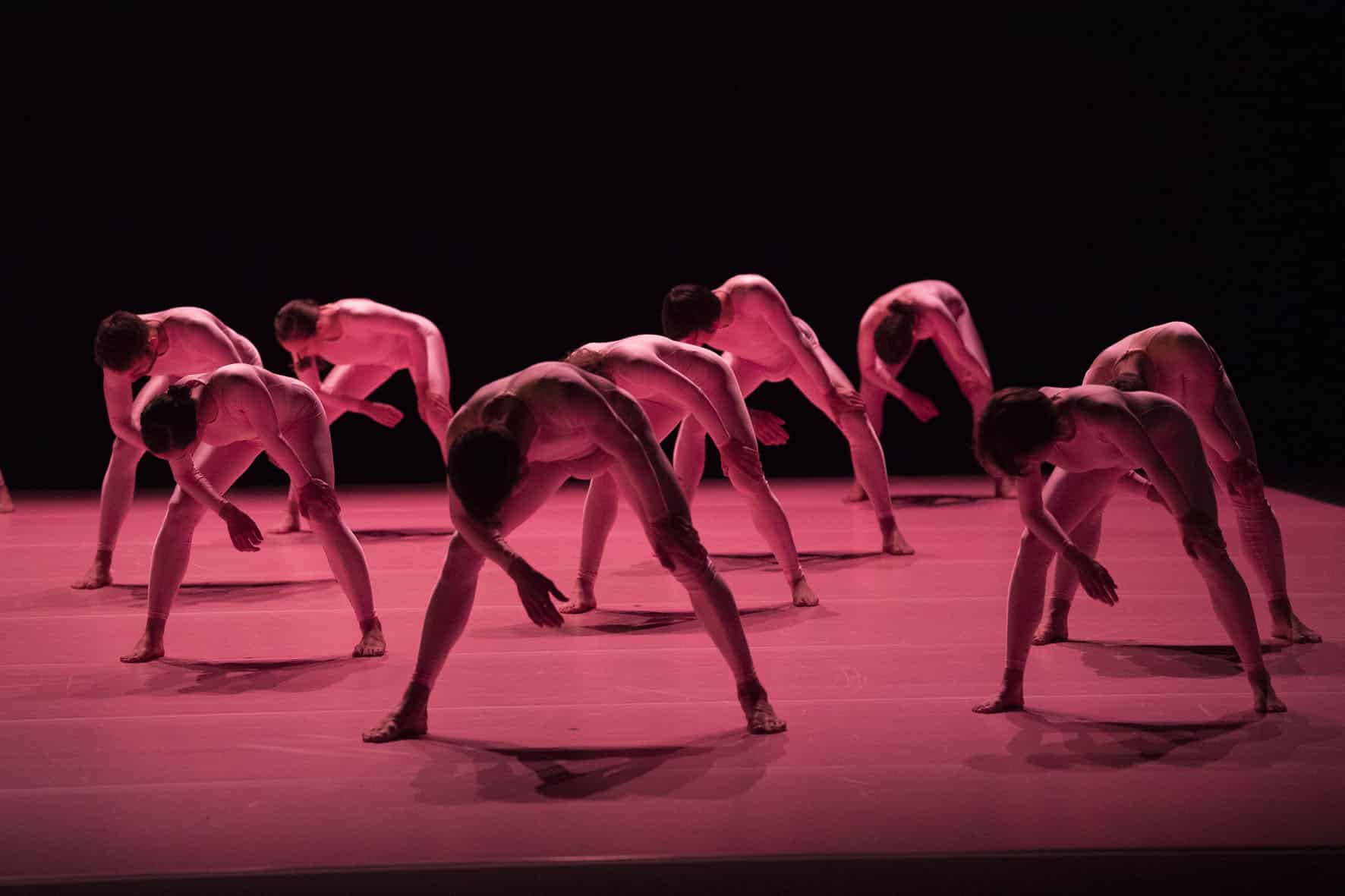
In collaboration with the Philharmonie de Paris and the Fondation Fiminco, Olivier Dubois recreates Come Out for his company in November 2026 (originally created in 2019 for the Ballet de Lorraine), set to Steve Reich’s music Come Out.
Come Out is rooted in a legacy of struggle.
The piece emerges from a specific historical event: the Harlem riots of 1966.
Steve Reich’s work begins with the sentence: “I had to, like, open the bruise up and let some of the bruise blood come out to show them.”
In Steve Reich’s music, this statement is repeated, fragmented, and distorted until it becomes a wave that saturates the space. In Olivier Dubois’ choreography, the body—upright at first, then besieged—becomes rhythm; violence becomes structure; memory becomes a battlefield.
And then there is hypnosis. This pink that unfolds through the bodies, through the singular states of each performer. This pink that is driven to the point of losing its original meaning. This pink that, over time and through effort, reveals the blood boiling beneath, the bruise slowly spilling out.
The performers carry this charge within them: they replay repetition as an act of resistance, giving shape to a community that refuses erasure. The dance unfolds, distorts, exhausts itself, and rises again.
Come Out is a choreographic manifesto.
A place where the contortion of time and body releases a testimony whose true meaning is neither elsewhere nor buried, but here, at the very heart of the material. And so, Come Out becomes a cry.
A human, collective work — an uprising.